
Discovering the Turk Aegean’s must-see ancient sites
Aphrodisias

The TurkAegean outshines with its several sights of universal historical value and continues to be a multilayered cultural landscape that attracts thousands of visitors all year-round.

Located in Aydın’s Geyre village, Aphrodisias and its marble quarries are amongst Türkiye’s most significant archeological sites. The site’s large temple, which was dedicated to Aphrodite and has come to be the symbol for the city’s ancient glamour, dates from the 3rd century BCE, a century before the city and its marble quarries were constructed. The site is located on a fertile terrain as it’s fed by the Morsynus River. It was home to the Cult of Aphrodite and was the capital of Caria, a much renowned Anatolian state.
Smyrna Agora

We must underline that there are enough remains dating to the ancient site to make it worth travelling across the cities for. Ruins of the Temple of Aphrodite, which include some columns and a few details, the Odeion, the stadium and the Sebasteion from where the famous sculptures exhibited in Sevgi Gonul Gallery are found are amongst to attractions you should make sure to discover here. The city’s stadium, 8,000-seat theatre, and council house will be a plus, and the stadium is amongst the best-preserved stadiums of the ancient world.

Smyrna Agora, modern Bayraklı in the city of Izmir, covers a rectangular area as would befit the grid city layout of the region. It bears the traces of the Hellenistic, Roman, Eastern Roman, Beylik (Principalities), and Ottoman periods. It also carries religious importance in that the Port was visited by two chief apostles, St. Paul and St. John, and was home to one of the seven churches of revelation.
Didyma

Latest excavations have revealed a city council that sits adjacent to the West Portiko, a public building, and an ancient bath. A recent discovery of an inscription implies that there was the Temple of Nemesis, the goddes of retribution & indignation adjacent to the Agora or just nearby. One of the structures that were found way earlier includes Kadifekale or the Acropolis of Smyrna, which shows the layers from Hellenistic to Ottoman period and offers insight into how defensive strategies have changed throughout centuries. You should be sure to visit the Acropolis, Basilica, Bouleuterion, Agora Bath, and West Portico when you visit the Agora of Smyrna.

Located on what was once called the Sacred Way, which connected it to Miletus, Didyma was not a city but a place of worship. It was well renowned in antiquity because of its famed oracle, meaning a prophetic prediction, and the colossal Temple of Apollo. The Temple, the third-largest temple of the ancient world, known as the Didymaion, consists of three layers, the earliest of which dates back to the 9th millennium BCE. The oracular practice that was observed here is unfortunately almost unknown to us though we have some information. We know, for example, that inquiries and answers were written down here, as opposed to Delphi, thanks to some written evidence that proves it. It’s also believed that the oracle, a gateway to knowing the will of the gods here was the most influential after the one Delphi.
Ephesus

Though the exact roots of the temple are, similarly, unknown to us, it is known that it carried much religious importance in the ancient world. The Temple, reconstructed in Hellenistic period, still shines in full glory and is definitely worth visiting. You are especially recommended to visit it as the sun sets as it creates the most picturesque landscapes then.

A UNESCO World Heritage site that lies among some lush green olive groves, the ancient city of Ephesus was a seaport that witnessed the journey of mankind toward a more settled life since the Neolithic age onward. It falls in the seaside province of İzmir on the Aegean coast and dates back to the 7th millennium BCE. The site’s heyday, however, can be dated around the 20s BCE when it served as a Roman capital.
Hierapolis

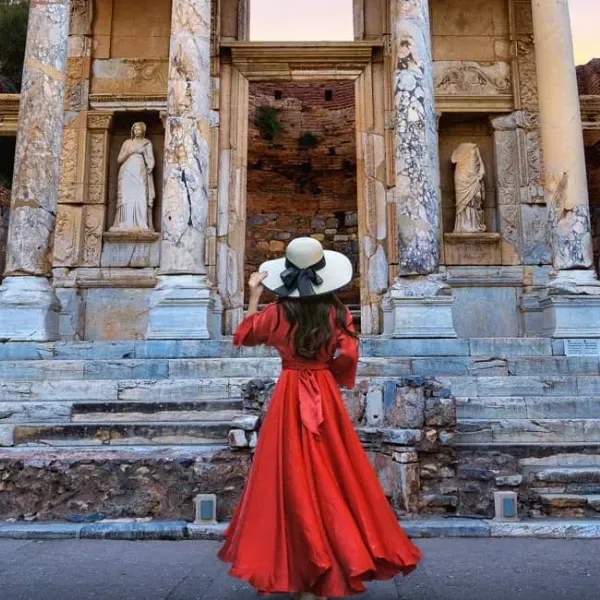
A city with such an outstanding historical value, Ephesus became a UNESCO World Heritage site in 2015. Once the commercial centre of the whole ancient world, it is a highly magnificent site that is home to “Terrace Houses,” the Library of Celsus, and the Temple of Artemis, one of the Seven Wonders of the Ancient World. Ephesus’ 25,000-seat ancient theatre still hosts many events and holds onto its historical importance. The nearby House of Virgin Mary, which is believed to be the last residence of hers, and the Basilica of St. Jean are also worth visiting.

Among the most famous and commonly visited ancient sites of the TurkAegean is Denizli’s Hierapolis, which was listed as a UNESCO’s World Heritage Site in 1988.
Kaunos

But there’s another feature of Hierapolis that makes it stand out among all other ancient sites of the world: It integrates plenty of cultural assets and an extraordinary natural heritage into one. The ancient town sits near the white travertine terraces and numerous pools to swim which are known to be excellent in their therapeutic virtues.

Kaunos refers to an archeological site that served as a significant port city in ancient times but lost this feature as alluvial deposit coming from the sea filled its basin and separated it from the present-day Sülüklügöl (Lake with Leeches).
Miletus

The acropolis is founded upon a 152-metre-high hill, and the theatre sits on a lower slope. Some remains that stand west of the theatre belong to a basilica, whereas others are parts of the ancient bath and temple. You are more than recommended to explore for yourselves these remains – and take notes lest you forget how they have rewritten human history.

Situated in Aydın’s present-day Söke district, the ancient seaport of Miletus dates back to the Neolithic period and holds onto its significance as the focal point of the history of philosophy. It was here that the foundations of rational thought, geometry, and astronomy were laid. Thales, Anaximenes, Anaximandros, Isidoros, one of the architects of Hagia Sophia, and Hippodamus, who was known as the “Father of City Planning” since he invented the grid urban pattern, lived here. Though the city owed its fame in large part to its port, its connection to the Aegean Sea broke out when Büyük Menderes River (Meandres) filled the basin with some alluvion deposit. The 15,000-seat ancient theatre is amongst the main attractions of the site.
Pergamon

The site’s cultural continuity is largely reflected in its layout where Christian, Jewish, and Muslim monuments and temples lay side by side. It is also reflected on the site’s large repertoire of inscriptions, including some that are addressed to Jews and some, to earlier civilisations. You should make sure to discover these inscriptions and visit the site’s colonnaded walkway, the Baths of Faustina, and the Temple of Apollo, which we can cite amongst its main attractions.

Located on theTurkAegean coast, in İzmir’s present-day Bergama district, Pergamon Ancient City once served as the capital of the Hellenistic Attalid dynasty. Its theatre which is situated on a sloping terrain surrounded by an extensive city wall, is in fact the steepest of the ancient world and offers perfect seascapes.
Priene

Known primarily for its Asclepieion healing centre, the site was added to the UNESCO World Heritage List in 2014. Its location in-between some lush green lands makes it particularly stand out, and its cultural-religious importance as one of the Seven Churches of Revelation is still maintained. In addition to the Asclepieion, whose sacred spring still flows, you should make sure to visit the monumental Red Hall (Kızıl Avlu), once a sanctuary dedicated to Egyptian deities, and the ruins of the Jewish Synagogue.

Situated 10 kilometers from the Aegean Sea, on a forested slope between the towering cliffs of its acropolis, the ancient city of Priene is steeped in history as an ancient city of Ionia. It gets its name from the Luwian word for “Citadel.” Its well-preserved structures and urban layout are quite famous as the latter is thought to be one of the earliest examples of city planning – the earliest example of grid layout, to be precise. The city’s remnants lie on successive terraces that rise from a plain, and we might therefore say that it’s not an easy terrain.
Sardes

Priene’s agora, which stood out as the site’s commercial and political centre, occupies two blocks of the ancient grid structure. Looking like a rectangular theatre, the Bouleuterion or Council Chamber lies next to the agora. The fact that these two lie side by side underlines the transparency that was observed in the administration of city-states.

Sardes refers to the ruined capital of ancient Lydian Kingdom where the money was invented. Located in the privileged location where it is surrounded by the fertile plain of the Gediz River, it was dominated by the ancient acropolis. It also became an important Christian centre, the site of one of the Seven Churches of Revelation. The major buildings and building complexes of the site include its well-preserved Lydian houses, late Roman houses, the Temple of Artemis, which is the fourth-largest Iconic temple in the world, an ancient bath-gymnasium complex, the theatre, and the synagogue, the largest in the ancient world.